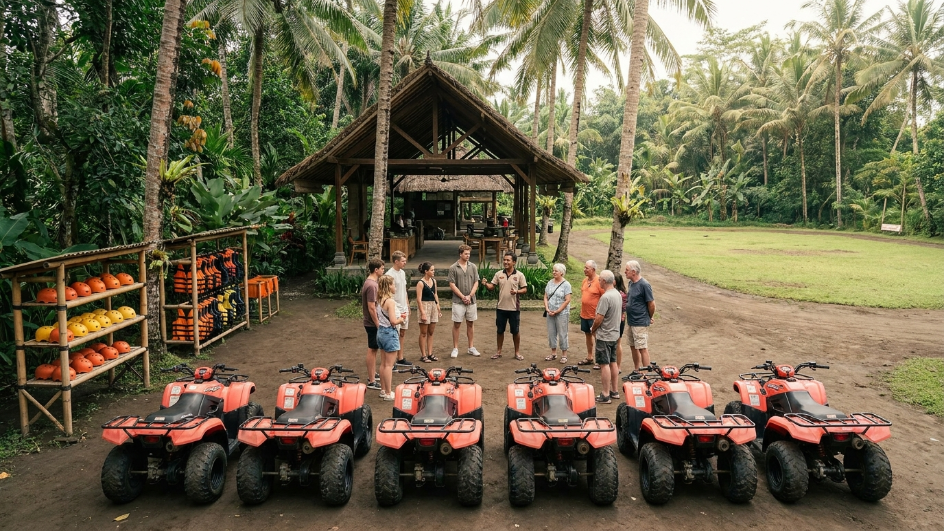
Here’s something almost every first-timer thinks the moment they arrive at a Bali ATV operator and sees the quad bikes lined up: wait, am I actually going to be able to do this?
That brief flash of doubt is completely normal. The ATVs look bigger in person than they do in photos. The jungle track disappearing into the treeline looks genuinely wild. And if you’ve never sat on a quad bike before, the whole setup can feel unexpectedly intimidating for about thirty seconds — until the pre-ride briefing starts and you realize, pretty quickly, that this is far more accessible than it looks.
Is Bali ATV safe for beginners? The short answer is yes — and the longer answer is what this guide is for. By the time you finish reading, you’ll know exactly how the bikes work mechanically, what the practice session actually covers, whether you need a license for Bali ATV, which easy ATV tracks in Bali are best suited for your first ride, and what genuine first-timers consistently say after completing their experience. No fluff, no false reassurance — just the practical information you need to show up confident.
What Makes Bali ATV Accessible for Complete Beginners
The single biggest misconception about first time ATV Bali experiences is that prior riding experience is required or even helpful. It isn’t — and the reason comes down to how the bikes are actually built.
Automatic Transmission: The Game Changer
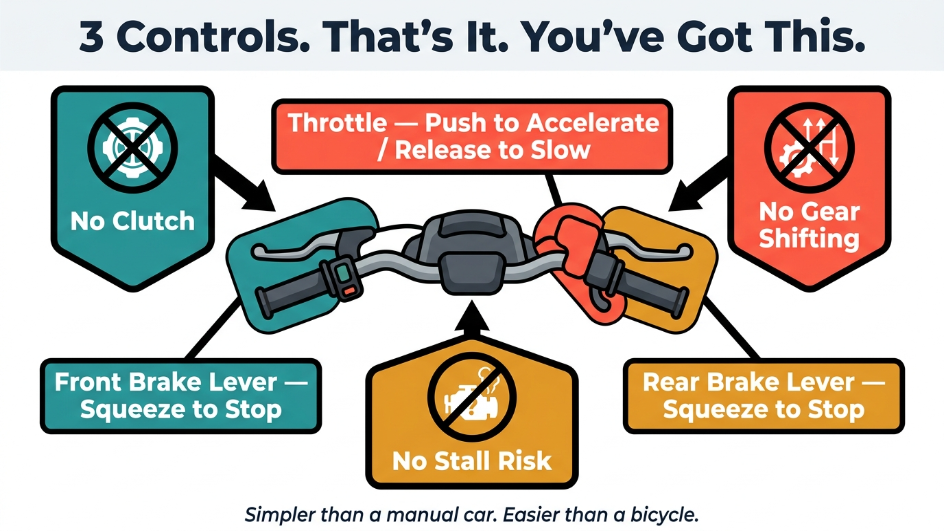
Every beginner-oriented ATV used in Bali’s tourist track operations runs on fully automatic transmission. There is no clutch. There is no gear shifting. There is no stall risk.
This is the detail that dissolves most beginner anxiety immediately when they hear it at the briefing. The mechanical operation of a beginner ATV in Bali is genuinely simpler than driving a manual car — in fact, it’s simpler than most people’s first experience on a bicycle, because the balance component is handled by four wheels rather than two.
The control interface breaks down to three inputs:
- Right thumb throttle: Push forward to accelerate. Release to decelerate.
- Hand brakes: Squeeze to brake — typically one lever per hand for front and rear brakes, clearly labeled.
- Steering: Standard handlebar steering, identical in principle to a bicycle or scooter.
That’s the complete mechanical picture. There are no additional inputs required for normal track operation. A beginner who has never ridden any motorized vehicle in their life can understand and apply all three inputs within minutes of the briefing — which is exactly what the practice session is designed to prove to them.
Purpose-Built Beginner Track Sections
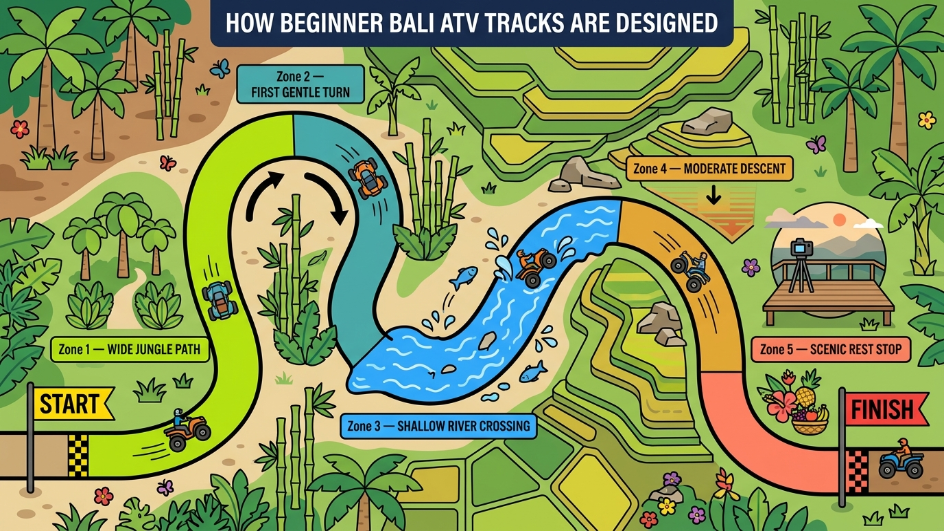
Reputable Bali ATV operators don’t send first-timers directly onto the same technical sections that experienced riders tackle. The track architecture at quality operators is deliberately tiered — beginner-friendly sections with wider paths, gentler gradients, and clear sightlines precede the more technical river crossings and steep descents.
This graduated exposure serves a specific function: by the time a first-timer reaches the more challenging sections of the track, they’ve already accumulated 20–30 minutes of actual riding experience. Their throttle control is intuitive, their braking reflex is established, and their confidence has built organically through successful navigation of the earlier sections. The track design is doing psychological and skill-building work simultaneously — and it works reliably.
What Happens at the Pre-Ride Briefing and Practice Session
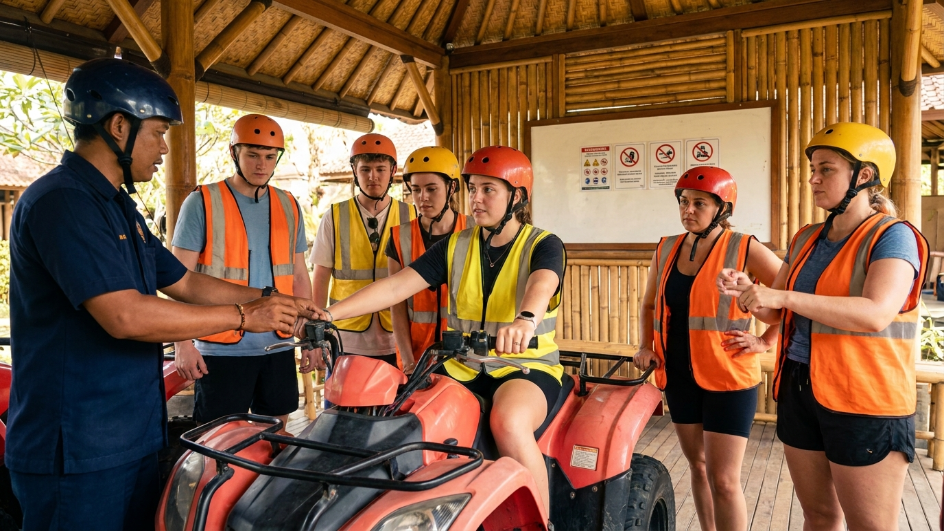
The pre-ride experience at quality Ubud operators is more comprehensive than most first-timers expect. It’s not a quick wave toward the track and a “good luck” — it’s a structured preparation sequence designed specifically to get beginners from zero to genuinely ready.
The Safety Briefing
Duration: typically 10–20 minutes depending on group size and complexity. A trained guide covers:
- Vehicle controls: Throttle, brakes, steering — demonstrated hands-on, not just described
- Track signals: Hand signals used by guides to communicate stop, slow down, and all clear — critically important for track safety
- Body position: How to lean on turns, how to shift weight on descents, where to look (ahead, not directly at the ground in front of the wheels)
- Emergency protocol: How to signal the guide if you feel unsafe or need to stop
- Track hazards: Specific callouts for the session’s conditions — wet sections, upcoming river crossings, current mud depth on key sections
The briefing is conducted in English at virtually all Ubud operators catering to international tourists, with visual demonstrations supplementing verbal instruction for any language gap.
The Practice Zone
Before any first-timer sets wheels on the actual jungle track, quality operators run a dedicated practice session in a flat, controlled area adjacent to the main briefing point. This is where the theoretical briefing becomes physical muscle memory.
In the practice zone, you’ll:
- Start the ATV and get familiar with the idle and throttle response
- Accelerate and brake repeatedly across a short flat stretch — building the instinctive relationship between thumb pressure and vehicle response
- Execute basic turns in both directions at low speed
- Practice an emergency stop from a slow roll — the most important reflex to have automatic before entering jungle terrain
The practice session typically runs 5–15 minutes depending on group experience level. First-timers who engage genuinely with the practice zone — rather than rushing through it — arrive at the track entrance measurably more confident and technically better prepared. Take it seriously even if it feels basic.
The Guide Convoy System
Once on the track, beginner groups operate in a guided convoy format: a lead guide on their own ATV sets the pace at the front, with the group following in single file. A sweep guide often brings up the rear to ensure no rider falls behind or encounters difficulty unobserved.
This format matters enormously for first-timers. You are never navigating alone. You never need to make independent decisions about which path to take or how to approach a technical section — the lead guide demonstrates the correct line and pace, and you follow. If you need to stop, signal the guide or the sweep — the group pauses.
The convoy speed is always calibrated to the least experienced rider in the group. First-timers are never pressured to keep up with a pace beyond their comfort level.
Do You Need a License for Bali ATV?
This is one of the most frequently searched questions about Bali ATV for beginners, and the answer is refreshingly simple.
The Direct Answer
No — you do not need a driving license of any kind to ride ATV in Bali as a tourist. Indonesian law does not require a driving license for ATV operation on private off-road tracks, which is what all Bali tourist ATV experiences operate on. These are privately managed jungle trails, not public roads — the licensing framework that applies to road vehicles simply doesn’t extend to closed off-road recreational tracks.
This applies regardless of your home country’s licensing requirements. Whether you hold a full driving license, a motorcycle license, a learner’s permit, or no license at all — the requirement is identical across all reputable Bali ATV operators: zero.
What Operators Do Require
In place of a license, operators require:
- Age verification: Most operators set minimum age at 16 for solo riding, with younger riders accommodated on tandem or guided formats
- Health declaration: A waiver covering medical conditions that could create risk — heart conditions, recent surgeries, pregnancy, back or neck injuries
- Sobriety: Operators can and do decline to brief riders who appear to have consumed alcohol — don’t show up after a boozy brunch expecting to ride
None of these requirements involve any formal government-issued credential. Your passport or ID serves purely as age verification if requested — not as a license check.
A Note on International Driving Permits
Some travelers arrive in Bali having purchased an International Driving Permit (IDP) specifically for ATV riding after reading outdated or incorrect information online. An IDP is entirely irrelevant for ATV track riding in Bali — don’t purchase one for this purpose. IDPs are relevant only for operating road vehicles on public Indonesian roads.
Easy ATV Tracks in Bali: What Beginners Should Look For
Not all ATV tracks are equally beginner-friendly, and knowing what to look for when comparing operators saves you from inadvertently booking a track that’s better suited to experienced riders.
Track Characteristics That Suit First-Timers
Distance and duration: For a genuine first-timer, a 2-kilometer beginner circuit or a 3–4 kilometer introductory track (approximately 1–1.5 hours of riding) is more appropriate than the 6–7 kilometer extended tracks marketed to experienced riders. Beginner tracks cover the same essential terrain types — jungle paths, a river crossing, a moderate descent — without the sustained technical difficulty of longer routes.
Track width: Beginner-appropriate tracks maintain consistent minimum width of 2–3 meters, allowing straightforward navigation without the precision steering required on narrow single-track sections. Narrow tracks demand more experienced spatial judgment than new riders have developed.
Gradient management: Look for tracks described as having “moderate” or “gentle” gradients. Steep descent sections are manageable for beginners within a guided convoy, but a track dominated by steep terrain throughout will feel overwhelming before confidence has built.
River crossings: These are actually one of the most exciting elements for beginners — and they’re generally manageable even for first-timers because the crossing speed is very slow and the guide demonstrates the correct line first. One or two shallow river crossings are a feature, not a hazard, for most beginners.
Questions to Ask the Operator Before Booking
Before committing to any easy ATV track Bali experience, ask these specific questions:
- “What percentage of your riders are first-timers?” — Quality beginner operators will answer “most of them” without hesitation.
- “How long is the practice session before the track starts?” — Any answer under 5 minutes is a red flag.
- “Is the guide at the front the whole time, or do riders go independently?” — Beginners should always have a lead guide.
- “What happens if I want to stop mid-track?” — The answer reveals the operator’s safety culture immediately.
- “How technical is your beginner track compared to your advanced track?” — Operators with genuine beginner infrastructure will have a clear, specific answer.
First-Timer Anxiety: Addressing the Real Concerns
Beyond the mechanical and logistical questions, there are emotional concerns that first-timers often have but don’t always voice at the booking stage. They’re worth addressing directly.
“What if I go too fast and can’t stop?”
The throttle on a beginner ATV is responsive but not hair-trigger sensitive. Releasing thumb pressure from the throttle immediately begins deceleration — the engine braking on a low-gear automatic ATV is significant. Squeezing either brake lever adds additional stopping force. On flat or moderate terrain, a beginner can bring an ATV from typical guided convoy speeds (15–25 km/h) to a complete stop well within 5–8 meters. The emergency stop practice in the practice zone exists specifically to make this reflex automatic before the track starts.
“What if I tip over?”
ATVs have a wider wheelbase and lower center of gravity than motorcycles, making tip-overs at normal guided track speeds genuinely rare. The scenario that creates tip-over risk — high-speed cornering, attempting technical sections beyond the rider’s ability — is structurally prevented by the guided convoy format and beginner-appropriate track design. At the speeds a beginner group moves, the ATV is fundamentally stable.
“What if I fall behind the group?”
The sweep guide at the rear of the convoy exists for this reason. You will not be left alone on the track. If you need to slow down, stop, or collect yourself after a tricky section, the sweep guide stays with you while the lead guide holds the group at the next rest point. This is standard operating procedure at quality operators — not an exception for special cases.
“What if I panic mid-track and want to quit?”
You can always stop and wait. Guides will arrange a return path or wait with you until you’re ready to continue. No reputable Bali ATV operator has ever stranded a rider on a jungle track because they wanted to stop. The correct protocol is simply to signal your guide — the same hand signal demonstrated in the briefing — and the convoy pauses.
What Real First-Timers Say After Their Bali ATV Experience
The most reliable reassurance for beginner anxiety isn’t technical specifications — it’s the consistent pattern in what first-timers report after completing their ride.
The single most common post-ride comment from first-timers across Bali ATV operators is some variation of: “I was so nervous before, and it ended up being so much easier than I expected.”
The second most common comment: “I wish I’d booked the longer track.”
Both of these are important signals. The anxiety going in is normal and almost universal among first-timers. The relief and enthusiasm coming out is equally consistent. The gap between how daunting it looks before the briefing and how manageable it feels twenty minutes into the ride is one of the most reliably pleasant surprises in all of Bali’s adventure activity menu.
Before You Arrive: First-Timer Preparation Checklist
| Preparation Item | Details |
|---|---|
| Clothing | Old long pants, closed-toe shoes, old t-shirt you don’t mind muddying |
| What to bring | Change of clothes in a waterproof bag, any personal medication |
| What to leave behind | Jewelry, expensive watches, anything you’d be upset to lose to mud |
| Food and hydration | Eat a solid meal 60–90 minutes before — not immediately before. Bring water. |
| Physical condition | Get a good night’s sleep. Avoid alcohol the night before and morning of. |
| Mindset | Engage seriously with the practice session. Ask questions at the briefing. |
| Booking timing | Morning slots (8–10am) are best for beginners — cooler, drier, less crowded |
Common Mistakes First-Timers Make
| Mistake | Why It Happens | How to Avoid It |
|---|---|---|
| Rushing through the practice zone | Excitement or peer pressure from the group | Treat it as the most important 10 minutes of the day |
| Looking at the ground directly in front of the wheels | Natural nervous instinct | Train yourself to look 5–10 meters ahead — guidance from the briefing |
| Gripping the handlebars too tightly | Anxiety response | Consciously loosen your grip on straight sections — reduces fatigue significantly |
| Not asking questions at the briefing | Fear of looking inexperienced | Every guide expects beginner questions — ask everything |
| Choosing operator purely on price | Budget priority | Cheapest operators often skip or shorten the practice session |
FAQ — Frequently Asked Questions
Is Bali ATV safe for beginners who have never driven anything motorized?
Yes — the automatic transmission, guided convoy format, dedicated practice session, and beginner-tiered track design collectively make Bali ATV one of the most accessible adventure activities available to complete first-timers. The majority of riders at tourist-oriented Ubud operators have no prior ATV or motorcycle experience. The activity is specifically designed around this reality.
Do I need a driving license for Bali ATV?
No. ATV riding on private off-road tracks in Bali requires no driving license of any kind — Indonesian or international. Age verification and a health declaration waiver are the only requirements. Do not purchase an International Driving Permit for this purpose.
How physically demanding is a beginner ATV track in Bali?
Moderately demanding in terms of grip strength and core engagement over 1.5–2 hours, but not exhaustively so for most adults in reasonable health. The most physically tiring element is sustained handlebar grip on bumpy sections — if you have wrist or hand injuries, flag this at the briefing. The cardiovascular demand is low to moderate; it’s more about sustained engagement than intense exertion.
What is the easiest ATV track in Bali for beginners?
Look for operators offering dedicated beginner or introductory circuits of 2–4 kilometers with a confirmed practice zone, guided convoy format, and explicit experience catering to first-timers. Check our Ubud ATV operator guide for specific operator comparisons with first-timer suitability ratings.
Can I do Bali ATV if I’m scared of driving?
Yes — and many people who describe themselves as scared of driving complete the experience successfully and enthusiastically. The key difference from road driving is the absence of traffic, the guided format, and the controlled environment. Most people who arrive nervous leave having had one of their favorite Bali experiences. Engage with the practice session, ask questions, and communicate your anxiety to your guide at the briefing — good guides adjust their coaching style accordingly.
Read also:
- Best Bali ATV Ride: Ultimate 2026 Guide & Top Tracks
- Kuber ATV vs Balaji ATV: Which Bali Track is Better?
Conclusion
Is Bali ATV safe for beginners? Unambiguously yes — when you choose an operator with a genuine practice session, guided convoy format, and beginner-appropriate track. The automatic transmission eliminates the biggest mechanical barrier. The practice zone builds real competence before the track starts. The guided format ensures you’re never alone or unsupported. And the license for Bali ATV question has the simplest answer of all: you don’t need one.
The nerves you feel looking at that quad bike before the briefing are completely normal — and they’ll be gone approximately fifteen minutes into your first jungle track. What replaces them is the specific, irreplaceable satisfaction of doing something that scared you and discovering it was spectacular.
Ready to lock in your first ride? Secure your Bali experience with easy and safe online payments at Bali Vouchers. Fast, secure, and hassle-free — just a few clicks to unlock your adventure!
Still have a question about your first ATV experience? Drop it in the comments — I’ll answer every single one.
Tags: Beginner Guide, ATV Tips, Safety, First Time ATV Bali, Bali ATV, Adventure Travel, Ubud Activities, Quad Biking Bali, Travel Tips, Outdoor Adventures